
Modernizing Vendor Discount Governance with Agentic Automation
A major Multi-Regional Home Furnishings Retailer who manages a vast network of vendor partnerships, each with specific contractual agreements regarding “Defective Allowances” (DFA), reached us with difficulties in managing the fluctuating discounts across thousands of product lines. These allowances are discounts provided by vendors to offset the costs of damaged or defective inventory.
As the enterprise scaled, it required a transition from fragmented, manual data entry toward a standardized, effective-dated management framework that could integrate seamlessly with their core financial and ERP ecosystems.
The Challenges
Before the intervention, the client faced significant operational risks rooted in legacy data handling and manual oversight:
- Temporal Logic Overlaps: Managing “effective-dated” records manually made it nearly impossible to prevent overlapping discount periods, leading to financial inconsistencies and revenue leakage.
- Operational Bottlenecks: Updates were largely handled via direct, manual SQL injections. This created a single point of failure, increased the likelihood of human error, and lacked a user-friendly interface for business stakeholders.
- ERP Synchronization Gaps: Maintaining continuity for specific flags such as automated ERP exclusion rules across new discount records was a complex manual task that often resulted in data fragmentation.
- Validation at Scale: The business required the ability to perform bulk quarterly updates via Excel, but doing so without bypassing validation rules posed a major threat to data integrity.
The Solution
We engineered a robust solution leveraging the Microsoft Power Platform underpinned by a centralized SQL Server architecture. This transition replaced fragile manual scripts with a sophisticated, governed application:
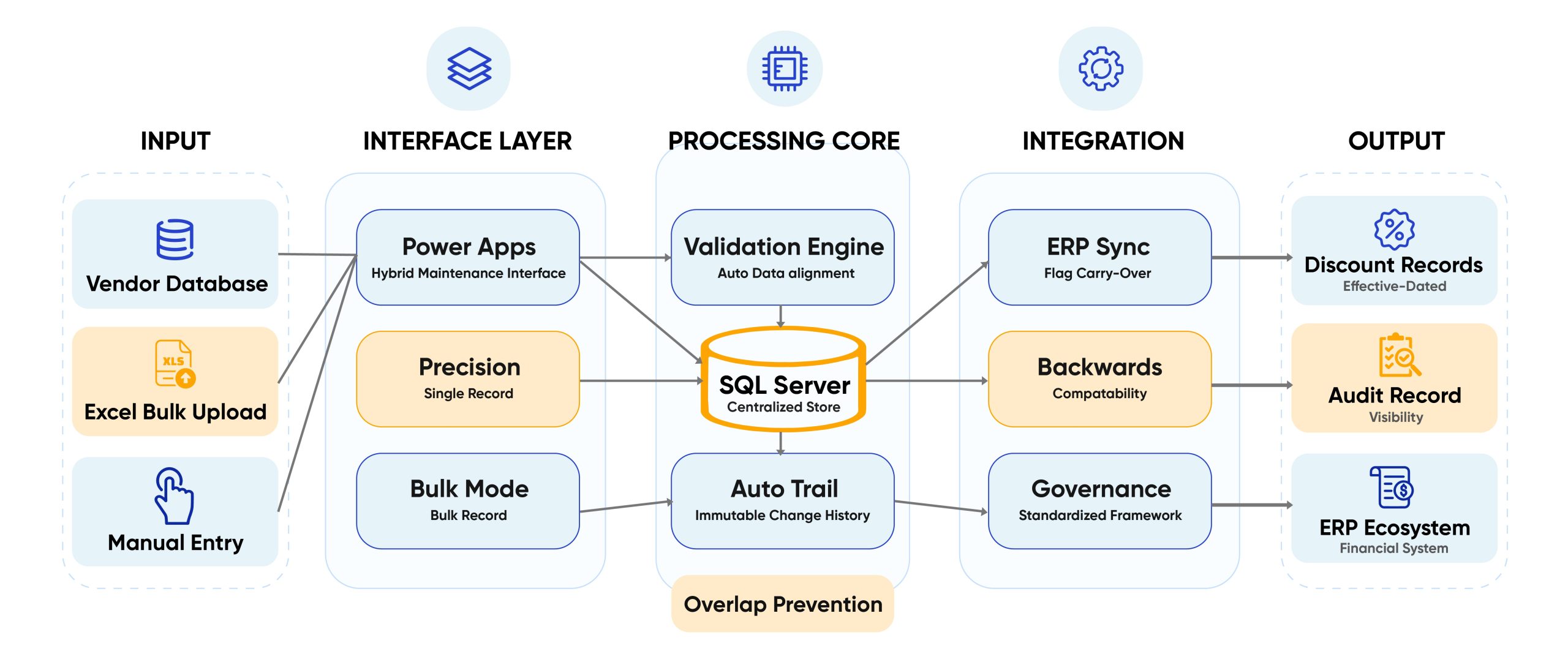
Solution Architecture
- Automated Validation Engine: We implemented workflow-driven logic that automatically enforces date alignment. When a new discount is entered, the system intelligently adjusts prior end-dates, ensuring a continuous, non-overlapping historical record.
- Hybrid Maintenance Interface: The solution features a custom Power App designed for two distinct workflows:
- Precision Mode: For single-record maintenance with real-time validation.
- Bulk Mode: A secure pipeline for quarterly Excel uploads that subjects bulk data to the same rigorous validation as individual entries.
- Enterprise Integration Layer: The architecture ensures “backwards-compatibility” by automatically carrying over ERP exclusion flags and prior vendor settings, maintaining alignment with the financial system of record without manual intervention.
- Governance & Audit Trail: Every change is captured within a standardized framework, transforming a “black box” SQL process into a transparent, auditable lifecycle.
Business Impact
The implementation of the automated Defective Allowance framework delivered immediate transformation across three key areas:
- Financial Integrity: By eliminating overlapping discount periods through automated validation, the client significantly reduced accounting risks and prevented potential revenue leakage.
- Operational Agility: Business users are now empowered to manage discount lifecycles through a low-code interface. This has minimized dependency on technical teams and accelerated the change management process for new vendor agreements.
- Audit Readiness: The platform provides executive-level visibility with a complete, immutable history of all vendor discount changes, ensuring the organization is always prepared for internal or external financial audits.
Conclusion
By replacing high-risk manual processes with a scalable, business-friendly ecosystem, this retailer has fortified its financial supply chain. This project demonstrates that modernizing “back-office” logic isn’t just about a new UI, but about building a reliable data foundation that supports enterprise-wide financial accuracy and long-term scalability.