How a Global Enterprise Unified Procurement Intelligence with a Snowflake-Native Analytics Platform
Jun 25, 2026 | 5 min read
As organizations grow across geographies, business units, and enterprise systems, gaining a unified view of operational and spend data becomes increasingly challenging. Disconnected data sources, limited visibility into supplier performance, and manual reporting processes often hinder timely decision-making. To overcome these challenges, many enterprises are turning to modern, cloud-native data platforms that centralize information and deliver actionable insights at scale. This case study explores how we transformed a leading global enterprise’s procurement analytics capabilities through a scalable data modernization initiative.
Key Challenges
As the client organization expanded across business units and ERP environments, procurement and finance teams struggled to derive timely, actionable insights from data spread across multiple systems.
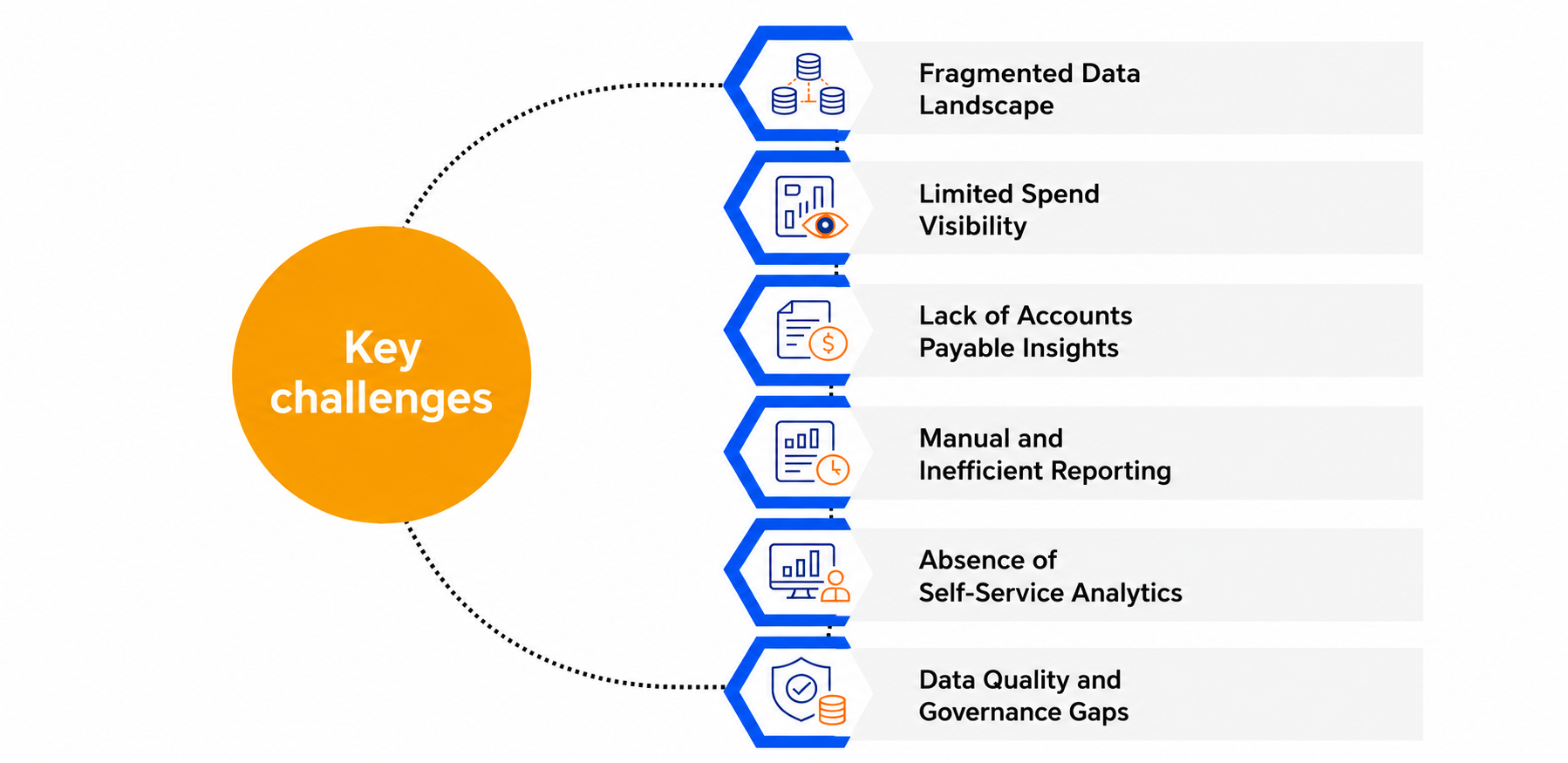
The core problems were:
- Data silos: critical procurement, supplier, and financial information lived in separate systems, with no unified view across operations or indirect spending categories.
- No common classification: the absence of standardized data structures and a spend classification framework limited visibility into spending patterns, supplier performance, and cost-optimization opportunities.
- Limited financial visibility: accounts payable metrics, payment-term compliance, and cash-flow trends were hard to monitor, hindering proactive financial management.
- Manual reporting: analysis depended on spreadsheet-based extraction, producing delays, inconsistent results and heavy effort.
- Technical dependency: business users had no self-service access and relied on technical teams for every report.
- Weak governance: limited data-quality controls and no single source of truth reduced confidence in business metrics.
Together, these gaps pointed to a clear need: a modern, governed analytics platform delivering trusted insight, operational efficiency, and scalable decision support.
Our Solution
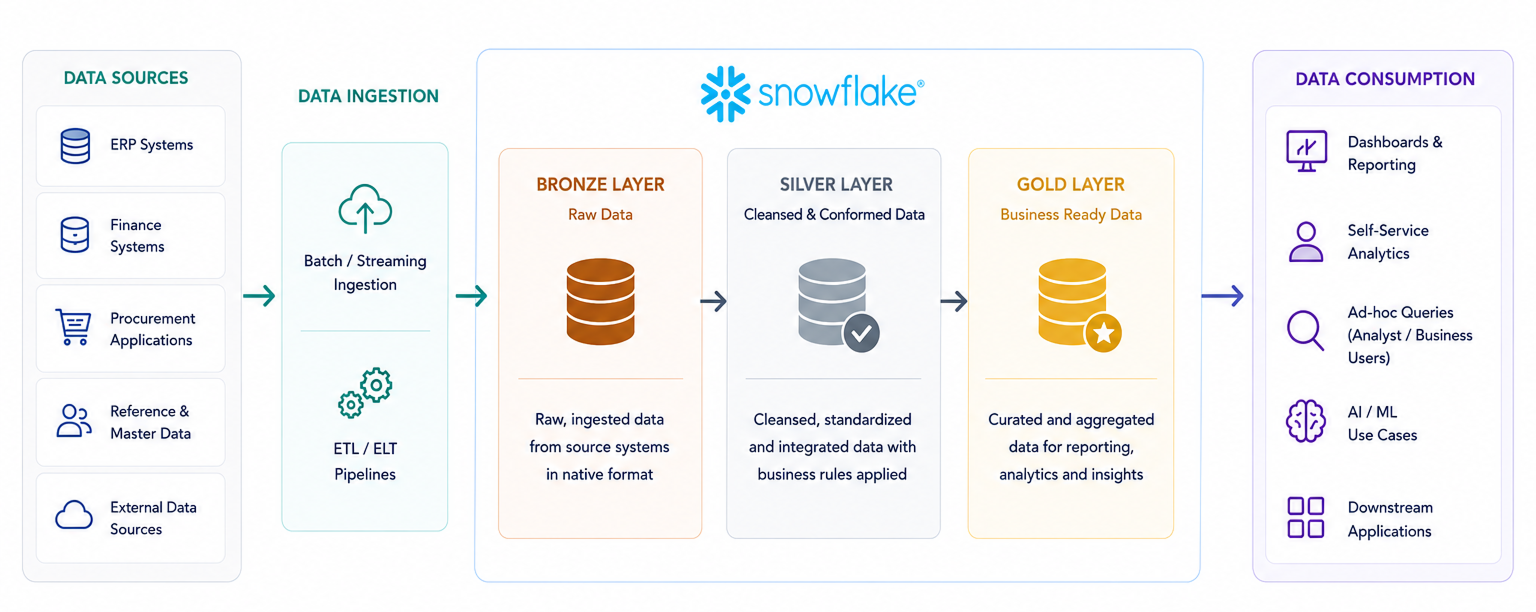
To address fragmented procurement and finance data challenges, a modern Snowflake-native analytics platform built on layered medallion architecture (Bronze, Silver, Gold) was implemented for scalability, governance, and business-ready analytics. The implementation followed a structured approach that transformed raw enterprise data into trusted insights while establishing a strong foundation for future AI and analytics initiatives.
- Phase 1: Data Foundation and Architecture
We designed and stood up a Snowflake Enterprise Data Warehouse on a medallion pattern, with dedicated Development, QA, Pre-Production, and Production environments for controlled release management. Core schemas were created to support staging, transformation, conformed storage, business-ready data marts, analytics workloads, data-quality management, auditing, and master-data governance. - Phase 2: Source Data Integration and Modeling
Procurement and finance data from JD Edwards, IFS, and Oracle Cloud Fusion were onboarded through structured ingestion pipelines, with raw source tables preserved in the staging layer in native format. We then designed conformed models that integrate supplier, purchase order, invoice, accounts payable, and item-master datasets into a single enterprise data model, applying business rules, field standardization, and referential-integrity validation.
Overall Solution Architecture
Snowflake-Native Enterprise Data Warehouse for Procurement Analytics
- Phase 3: Data Engineering and Governance
We built end-to-end ELT pipelines in dbt to automate data movement across the bronze, silver, and gold layers, with transformation logic to cleanse, validate, enrich, and standardize data before publishing. Automated data-quality checks, exception handling, audit logging, metadata management, and lineage tracking were embedded throughout the lifecycle for governance and operational transparency. - Phase 4: Procurement Intelligence Framework
We designed a standardized spend classification framework that organizes transactions into consistent business categories using a priority cascade (GL account, commodity code, and supplier mapping). Category mappings, supplier hierarchies, reference datasets, and business definitions were agreed with stakeholders and codified in the model which serves as the foundation for spend analysis, supplier evaluation, and financial monitoring across all three ERPs. - Phase 5: Analytics and Reporting Layer
We developed business-ready datasets and semantic models in the Gold layer and built interactive Power BI dashboards on DirectQuery to Snowflake, secured with row-level security. The reporting suite gives visibility into procurement operations, supplier spend, accounts payable aging, payment compliance, and purchase-order reconciliation. - Phase 6: AI and Self-Service Analytics
The final phase exposed curated data through a semantic layer powered by Snowflake Cortex, enabling natural-language querying and AI-assisted analysis for self-service exploration. Security controls, access policies, and governance standards were applied to ensure controlled access to business information across the organization.
Business Impact
The platform delivered a unified view of procurement and finance data, giving stakeholders trusted insight across suppliers, spend categories, cost centers, and business units from a single source of truth. Specifically, the engagement:
- Replaced manual, spreadsheet-based reporting with automated analytics, cutting reporting effort by 100 % and accelerating decision-making.
- Improved financial monitoring through clear visibility into AP aging, payment compliance, and outstanding liabilities, supporting better working-capital management.
- Strengthened compliance with automated reconciliation and validation, reducing the effort to identify and resolve transaction discrepancies.
- Empowered business users with self-service dashboards, reducing dependency on technical teams.
- Established a governed, scalable foundation ready for additional ERP integrations, advanced analytics, and AI-driven decision support.
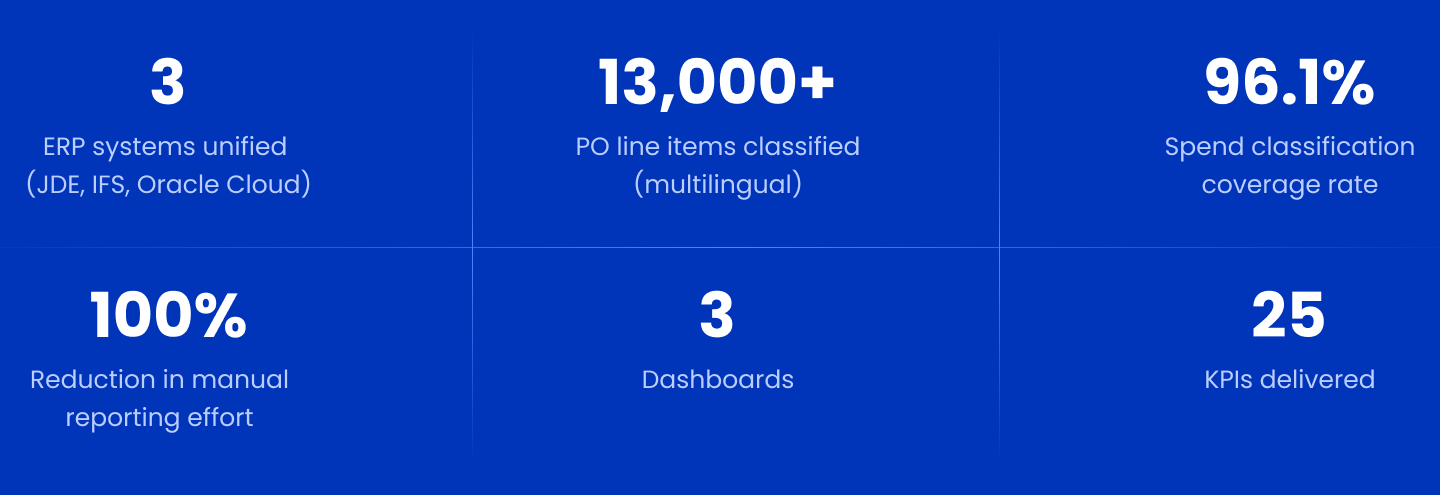
By establishing a governed and scalable analytics foundation, the organization improved confidence in business metrics while creating a future-ready platform capable of supporting additional ERP integrations, advanced analytics, and AI-driven decision support initiatives.
Conclusion
This engagement demonstrated how a modern, cloud-native data platform can rapidly transform fragmented procurement and finance data into a strategic business asset. More importantly, the initiative proved that data modernization is a true business enabler. Through a structured approach combining data engineering, analytics, governance, and AI readiness, the organization gained a scalable framework for driving operational excellence and financial optimization. With a scalable architecture, standardized data models, and strong governance controls in place, the organization is now well-positioned to accelerate its digital transformation journey and unlock greater value from its data for years to come.